Identifying Authentic Mathmos Models
Base Stamps and Moulding Marks
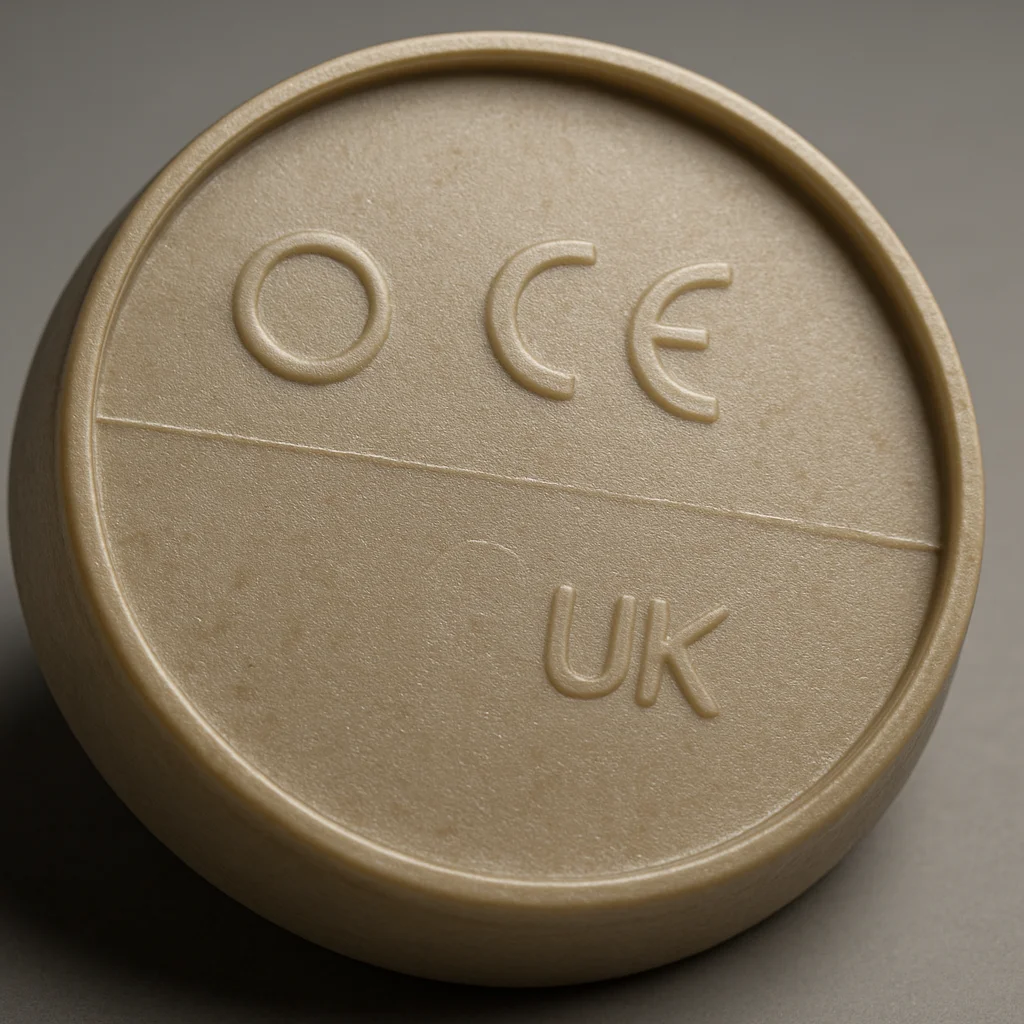
The most reliable starting point for authentication is the underside of the lamp’s base. Genuine Mathmos units — produced under that name from 1992 onwards, following the rebranding of Crestworth by Cynthia Czerski — carry a base stamp that reflects the registered company name, country of manufacture, and applicable electrical safety certification marks. Pre-rebranding Crestworth units from the 1960s and early 1970s bear their own distinct stampings, typically including the Crestworth Ltd name alongside British manufacturing details. It should be noted that the precise typography, stamp depth, and layout of these markings changed across production periods, and cross-referencing against the Serial Number & Marking Reference is strongly recommended before drawing conclusions from any single feature.
Reproductions and unlicensed derivatives — which increased considerably in volume during the 1990s and 2000s as demand for retro decorative items grew — frequently omit one or more of these elements, or render them with inconsistencies in font weight and spacing that are detectable under magnification. The moulding quality of the base itself is also a useful indicator: authentic units from established production runs exhibit a consistent surface finish and parting-line placement that is generally absent from lower-specification copies.
Globe Construction and Liquid Characteristics
The glass globe — referred to internally by Mathmos as the globe rather than the bottle — is a significant authentication point, though one that requires caution given that globes have frequently been separated from their original bases over decades of use and resale. Authentic Mathmos globes from the principal production runs exhibit a specific wall thickness and glass clarity that differs measurably from reproduction equivalents. The ground glass neck finish on older Crestworth-era units is particularly distinctive and was not replicated consistently by later imitators.
The behaviour of the wax compound and translucent liquid within the globe, while not a definitive authentication tool on its own, can serve as corroborating evidence. The proprietary formulations used across different Mathmos production periods produce characteristic flow patterns, blob cohesion rates, and colour combinations that are documented within the Mathmos Model Catalogue. Unusually rapid separation, persistent clouding of the liquid medium, or colour combinations not recorded in the known variant documentation should prompt closer scrutiny of other authentication markers.
Caps, Caps Markings, and Cord Sets
The metal cap fitted to the top of the globe, and the corresponding base collar, underwent documented design revisions at several points in the production history. The cap was redesigned circa 1971 during the late Crestworth period, and further modifications to surface treatment and fitment tolerances are observable on units produced after the Mathmos rebranding. These details are covered more fully in the Dating Production Runs by Physical Markings guide, which provides a period-by-period breakdown of cap variants.
Cord sets and plugs, where original, provide useful secondary dating evidence rather than primary authentication, since cords are among the components most commonly replaced during the functional life of a lamp. Nevertheless, the presence of a period-correct moulded plug with appropriate British or European standard markings — consistent with the inferred production date of the unit — supports rather than establishes authenticity.
Packaging and Documentation
Where original packaging survives, it constitutes some of the strongest supporting evidence available to a researcher. Box typography, colourway, and instructional insert design all changed at identifiable points, and several documented examples with intact packaging are recorded in the Provenance & Auction Record Notes. Reproductions rarely arrive with period-accurate packaging, and where packaging is present on a suspected reproduction, the print registration quality and cardboard stock specification frequently diverge from original examples.
Taken together, these categories of evidence — base markings, globe construction, cap variants, cord sets, and packaging — form the basis of a systematic authentication approach. Readers requiring further context on how these markers interact with condition assessment and collectible grading will find relevant discussion in the Preservation-Grade vs. Interventionist Restoration guide.